Specialty rigs.

I figured I’d talk about some specialty rigs for soft plastics. By now everyone knows about the effective drop shot rig, the split shot rig, doodling and of course the Texas rig but there are other ways of rigging plastics that are not as well known yet they are very effective.

Today I’ll talk about wacky rigging and a few different variations of it. All a wacky rig consists of is a worm type bait, and a hook. The difference between this rig and your normal way of rigging is instead of hooking through the nose you run the hook through the “Egg Sack” on the plastic leaving the hook tip exposed.

Another way of hooking it is to place an O-ring on your worm and run the hook under it so the hook itself never penetrates the plastic. With this style of rigging you can save money because your plastics don’t get torn up as easily and we all know how expensive they can get, especially when were talking Senkos.

To fish a wacky rig you just toss it out, give it slack and let it sink. If you don’t get bit on the initial fall pull it up by lifting your rod tip slowly and let it fall on slack line. I cant stress this enough, WATCH YOUR LINE! The bites can be very light. If it seems to be sinking more than it should or moves to one side, especially if it moves up current, reel down the slack, feel the pressure and set the hook, don’t be asleep at the reel! Slow is the biggest trick to fishing a wacky rig. This is not a technique that will cover a lot of water but it will produce bass, especially when the conditions are tough.

Next lets discuss the Izzy rig. This rig is basically just a modified wacky rig with a nail weight inserted into the head of whatever plastic worm type bait you feel like using. Experiment as to how much weight you need to put in, let the fish tell you how quickly they want it sink. A floating worm seems to be the most effective type to use for this rig because the nose will go down and the tail will float up but any type of worm will work. Here again, it can be hooked either through the egg sack or you can utilize an O-Ring.

The origins of the name stem from a gentleman named Izzy Byrd from San Jose who brought this style of fishing into the lime light, at least here in the states. Rumor has it that he learned it while in Japan on a business trip Irregardless of where he learned it he fished Pro/AM tournaments out of the back of the boat and just smoked everyone. As to how to fish it, use the same technique as you would a regular wacky rig.

Another variation of the Izzy rig comes from Korea and its called a Neko Rig, I’m not sure of the origin of the name but instead of using a nail weight in the head you use a small round jig head. You can purchase specialty ones or you can get your basic crappie type jigs and either cut the hook and the bend or just straighten it out.

Experiment with various ways of rigging the wacky rig. I’ve seen people catch bass using full sized bass jig heads hooked through the center of their plastics as well as small crappie jig heads. Remember, nothing is written in stone when it comes to bass fishing, you just might come across something different that just whacks them by thinking outside the box.

Thanks for visiting my site. Be sure to tell all of your fishing buddies and come back soon

Until Next Time, Good Luck and Tight Lines To Ya!

What a Great Fishing Trip!

I took the nephew for a day of fishing recently over to my home lake, Isabella and we had a blast! We pulled out of town at 0445 and headed over to the lake.

As we were driving along shortly after cresting Walker pass, we rounded a turn and there in the middle of the road was a deer, luckily we were going slow enough to be able to stop. As we drive along I noticed that all of the cows in the fields were feeding. This is something I have always watched for ever since I was a kid. Shhh, it’s a secret that my dad shared with me. On your next trip, take note if nature in general is active, if it is then chances are the fish will be active as well.

So we arrive at the lake and splash the boat, I can hardly wait till Josh, my nephew, is old enough to pull the truck up into the parking lot so we don’t have to tie off to the dock and block access for others to launch, even though its just for a couple minutes.

Lucky Craft Sammy Topwater LuresSo off we go to my first spot. We start out tossing Sammy’s looking for the top water bite and the bass didn’t let us down. We caught 7 nice bass pretty quick then it just died so instead of slowing down the presentation I make the call to fire up the Mercury and off we go to spot number 2 looking for more active bass.

SPRO  BBZ-1 Shad SwimbaitsAs we pull up to the spot I notice that the water looked “nervous”. What I mean by that is it looked “rippley” yet there was no wind, woo hoo, shad activity. I pick up my BBZ1 slow sinking shad and make a long cast. After it hits the water I do a ten count and ten start to reel, BAM! A good solid 3 pounder. Josh decides he wants to switch to a Spinner bait and on his first cast he sticks my fish’s twin brother. We continue to catch bass, 4 more, for about the next ½ hour then the spot dies as well. So that’s 13 bass and we’ve only been on the water for about 1 ½ hours, looks like its gonna be a great day. Time to make a move to find more actively feeding bass so off we go to spot number 3.

Norman Lures  Professional Edge  Crankbaits - DD14 & DD22Next spot I try tossing the big trout swim baits for awhile but I’m not getting any followers. Meanwhile Josh manages to put 2 more bass in the boat on his blade so I figure I’ll switch up to a DD22. After about 5 casts it felt like I got stuck on a rock so I try pulling it free when all of the sudden it starts to move off. “Holy Crap, that’s not a rock!” and the fight begins. I look at Josh and tell him, “This is a good one, grab the net.” I would reel up 10 feet and the fish would take 20 back. After what seems like forever I finally get him to the boat and he turns out to be a 8 pound channel catfish, that’s dinner so in the livewell he goes. We continue to fish the spot and manage to put 3 more decent bass in the boat.

The time now is about 9:00, the reaction bite seems to have slowed down some but we’ve managed to catch 18 bass and 1 catfish, what fun.

I continue to throw my DD22 and Josh has switched to a Deep Little N, we are working this rock pile in 12 foot of water when we get a double hookup, once again we boat twin 3 pounders. 2 casts later Josh says to me, “Uncle Mike, I’m stuck” I tell him to use the bow technique to pop it free so he does and the lure pops free. As soon as it comes free from the rock pile I notice the line moving towards the boat and Josh is not reeling it. He finally catches up to the fish and realizes he has a big one., it ends up being a 6 pound catfish which goes into the livewell so the other cat now has a room mate.

Gary Yamamoto Senko - 5''After about 30 more casts without a bite I toss a Senko onto the rock pile and WACK, another good bass in the boat. Josh wants to try a drop shot. We continue to work the rock pile but nothing is happening, the bass seem to have shut off so now its crappie time.

Crappie Thunder  Road RunnerWe move off to the trees in the channel and look for them on the Lowrance. After checking 3 stets of tree, bingo, there they are. Roadrunner time! We lost count of just how many crappie we caught but by the time we were done the second livewell had a limit of good 1 ½ to 2 pound crappie in it, yes they were packed in there like sardines, HA! Lucky for them my Champion has deep livewells.

The time is now about 11:30 and we deciede to call it a day and what a great day its been, 21 bass, 2 catfish and a limit of crappie. We stop by the fish cleaning station at Paradise cove and fillet out our catch of catfish and crappie and Josh calls up his mom and my other sister to let them know that were having a fish fry.

On the ride home Josh asks me why all fishing days are not like today was. I explain to him that they all cant be like today but the more times a person goes fishing the better the odds of having a day like today, as long as he learns something from every trip

Its days like this that keep kids interested in fishing and make the days when you only get a couple bites worth it to them because they know the potential is always there of having a great day!

Thanks for visiting my site. Be sure to tell all of your fishing buddies and come back soon

Until Next Time, Good Luck and Tight Lines To Ya!

Supercharger vs Turbo Charger

Recently I’ve been hearing people going back and forth between which is better, the Supercharger or the Turbo charger. I can honestly say that I did a bunch of research, the little woman says that I research the heck out of everything I do, befiore going with the Magnacharger Radix Supercharger system instead of a turbo. For my needs I found the Supercharger more efficent for my appkication. I wanted to be able to use my Silverado as a daily driver, increase my mileage while hauling my bass boat and from time to time smoke the Rice burners with their loud “fart cans” and all the while NOT voiding my warranty as well as keeping my vehicle within CARB standards seeing how I live in the wonderful state of California.

After determining that the Supercharger was the right one for me I once again did major research before I went with the MagnaCharger System. Its a complete bolt on system right down to new injectors that is basically plug and play. As a matter of fact if you have basic mechanical skills and basic habd tools you can install the system by yourself in an afternoon. The only time you would need help is setting the new assembly onto the block, its kind of heavy and you want to be sure everything lines up correctl

To help clear up all the confusion between the 2 I copied the following was from Superchargersonline, its a good read if your thinking about adding some major boost to your rig.

It’s one of the most common questions we are asked – the answer to which is almost impossible to find “What is better – a supercharger or a turbo?”

We only wish the answer were that simple, but unfortunately it is not. The simple answer is: “It depends.” But don’t worry, we’ll go into more depth than that here. Both superchargers and turbos have distinct advantages and disadvantages. Selecting the right kind of forced induction for your vehicle will depend upon your particular vehicle, your driving habits, your power preferences, and your needs.

Clearing Up Confusion

According to Merriam-Webster’s dictionary, a supercharger is defined as:
“a device (as a blower or compressor) for pressurizing the cabin of an airplane or for increasing the volume air charge of an internal combustion engine over that which would normally be drawn in through the pumping action of the pistons”.
A turbocharger is defined as:
“A centrifugal blower driven by exhaust gas turbines and used to supercharge an engine”.

According to Webster’s, a turbocharger is included in the definition for superchargers – it is in fact a very specific type of supercharger – one that is driven by exhaust gasses. Other superchargers that do not fall into this category – the kind that we are all used to hearing about – are normally driven directly from the engine’s crankshaft via a crank pulley. So in reality, it is not fair to compare all superchargers to turbochargers, because all turbochargers are also superchargers. For the purpose of this discussion, however, a supercharger will be considered all superchargers that are not driven directly by the engine, while turbochargers will be considered all superchargers that are driven by engine exhaust gasses.

Similarities

Both superchargers and turbochargers are forced induction systems and thus have the same objective – to compress air and force more air molecules into the engine’s combustion chambers than would normally be allowed at atmospheric pressure here on Earth (14.7 psi at sea level). The benefit of forcing more air molecules into the combustion chambers is that it allows your engine to burn more fuel per power stroke. With an internal combustion engine, burning more fuel means that you convert more fuel into energy and power. For this reason, supercharged and turbocharged engines normally produce 40% to 100%+ more power (depending on the amount of boost – check out our horespower calculator) than normally aspirated engines.

How They Work

A supercharger is mounted to the engine and is driven by a pulley that is inline with the crank (or accessory) belt. Air is drawn into the supercharger and compressed by either an impeller (centrifugal-style supercharger), twin rotating screws (screw-type supercharger), or counter-rotating rotors (roots-type supercharger). The air is then discharged into the engine’s intake. Faster crank speed (more engine rpm) spins the supercharger faster and allows the supercharger to produce more boost (normally 6 to 9 psi for a street vehicle). Typical peak operating speeds for a supercharger are around 15,000 rpm (screw-type and roots style superchargers) and 40,000 rpm (centrifugal-style superchargers).

A turbocharger operates in much the same way as a centrifugal (internal impeller) supercharger, except it is not driven by pulleys and belts attached to the engine’s crank. A turbo is instead driven by exhaust gasses that have been expelled by the engine and are traveling through the exhaust manifold. The exhaust gas flows through one half of the turbocharger’s turbine, which drives the impeller that compresses the air. Typical operating speeds of a turbocharger are between 75,000 and 150,000 rpm.

Head to Head Comparison

Now it’s time to evaluate the turbocharger versus the supercharger according to several important factors.

Cost
The cost of supercharger and a turbocharger systems for the same engine are approximately the same, so cost is generally not a factor.

Lag
This is perhaps the biggest advantage that the supercharger enjoys over the turbo. Because a turbocharger is driven by exhaust gasses, the turbocharger’s turbine must first spool up before it even begins to turn the compressor’s impeller. This results in lag time which is the time needed for the turbine to reach its full throttle from an intermediate rotational speed state. During this lag time, the turbocharger is creating little to no boost, which means little to no power gains during this time. Smaller turbos spool up quicker, which eliminates some of this lag. Turbochargers thus utilize a wastegate, which allows the use of a smaller turbocharger to reduce lag while preventing it from spinning too quickly at high engine speeds. The wastegate is a valve that allows the exhaust to bypass the turbine blades. The wastegate senses boost pressure, and if it gets too high, it could be an indicator that the turbine is spinning too quickly, so the wastegate bypasses some of the exhaust around the turbine blades, allowing the blades to slow down..
A Supercharger, on the other hand, is connected directly to the crank, so there is no “lag”. Superchargers are able to produce boost at a very low rpm, especially screw-type and roots type blowers.

Efficiency
This is the turbo’s biggest advantage. The turbocharger is generally more economical to operate as it as it is driven primarily by potential energy in the exhaust gasses that would otherwise be lost out the exhaust, whereas a supercharger draws power from the crank, which can be used to turn the wheels. The turbocharger’s impeller is also powered only under boost conditions, so there is less parasitic drag while the impeller is not spinning. The turbocharger, however, is not free of inefficiency as it does create additional exhaust backpressure and exhaust flow interruption.

Heat
Because the turbocharger is mounted to the exhaust manifold (which is very hot), turbocharger boost is subject to additional heating via the turbo’s hot casing. Because hot air expands (the opposite goal of a turbo or supercharger), an intercooler becomes necessary on almost all turbocharged applications to cool the air charge before it is released into the engine. This increases the complexity of the installation. A centrifugal supercharger on the other hand creates a cooler air discharge, so an intercooler is often not necessary at boost levels below 10psi. That said, some superchargers (especially roots-type superchargers) create hotter discharge temperatures, which also make an intecooler necessary even on fairly low-boost applications.

Surge
Because a turbocharger first spools up before the boost is delivered to the engine, there is a surge of power that is delivered immediately when the wastegate opens (around 3000 rpm). This surge can be damaging to the engine and drivetrain, and can make the vehicle difficult to drive or lose traction.

Back Pressure
Because the supercharger eliminates the need to deal with the exhaust gas interruption created by inserting a turbocharger turbine into the exhaust flow, the supercharger creates no additional exhaust backpressure. The amount of power that is lost by a turbo’s turbine reduces it’s overall efficiency.

Noise
The turbocharger is generally quieter than the supercharger. Because the turbo’s turbine is in the exhaust, the turbo can substantially reduce exhaust noise, making the engine run quieter. Some centrifugal superchargers are known to be noisy and whistley which, annoys some drivers (we, however, love it!)

Reliability
In general, superchargers enjoy a substantial reliability advantage over the turbocharger. When a turbo is shut off (i.e. when the engine is turned off), residual oil inside the turbo’s bearings can be baked by stored engine heat. This, combined with the turbo’s extremely high rpms (up to 150,000rpm) can cause problems with the turbo’s internal bearings and can shorten the life of the turbocharger. In addition, many turbos require aftermarket exhaust manifolds, which are often far less reliable than stock manifolds.

Ease of Installation
Superchargers are substantially easier to install than a turbos because they have far fewer components and simpler devices. Turbos are complex and require manifold and exhaust modifications, intercoolers, extra oil lines, etc. – most of which is not needed with most superchargers. A novice home mechanic can easily install most supercharger systems, while a turbo installation should be left to a turbo expert.

Maximum Power Output
Turbos are known for their unique ability to spin to incredibly high rpms and make outrages peak boost figures (25psi+). While operating a turbocharger at very high levels of boost requires major modifications to the rest of the engine, the turbo is capable of producing more peak power than superchargers.

Tunability
Turbochargers, because they are so complex and rely on exhaust pressure, are notoriously difficult to tune. Superchargers, on the other hand, require few fuel and ignition upgrades and normally require little or no engine tuning.

Conclusion

While the supercharger is generally considered to be a better method of forced induction for most street and race vehicles, the turbo will always have its place in a more specialized market. Superchargers generally provide a much broader powerband that most drivers are looking for with no “turbo lag”. In addition, they are much easier to install and tune, making them more practical for a home or novice mechanic.

Revo, Low Profile Baitcasters:

Abu Garcia  REVO  STX Lo-Profile Baitcast ReelsEver since I can remember I have been a Round Abu Garcia Reel man, I loved the tried and true design of the reels. Now don’t take that statement wrong. I still love and use my round Abu reels, especially my Abu Morrum’s but this is not about them, its about the new Abu Revo low profile baitcasters.

Not to long back, I believe it was around 2006 Abu Garcia introduced its new line of low profile baitcast reels. There is the Revo S, Revo SX, Revo STX, Revo Winch, Revo Skeet, Revo Premier, Revo Inshore and Revo Toro.

I personally think that Revo reels are kind of cool looking, and the specifications on them are pretty impressive as well. They all come with the following, an oversized main drive gear and X-CrafticTM aluminum alloy frame that provides corrosion resistance, which Abu says will stand up to salt water use. High Precision Corrosion Resistant ball bearings for smooth casting and retrieving and world renowned Carbon MatrixTM drag system which they claim will generates up to 24 lbs. of drag, precision machined DuragearTM brass gears for torque, and a six-pin centrifugal braking system. The STX series also adds a Linear Magnetic BrakeTM system. Most Revo models are available in either right or left hand retrieve depending on your needs. The High Precision Corrosion Resistant Stainless Steel ball bearings range from 6 in the Premier series up to 11 in several other series.

Abu Garcia  REVO  Skeet Reese Baitcast ReelsAnother thing I love about the Revo reels is the way Abu stayed with its simplistic design making it easy to service yourself. Basic cleaning oiling and greasing is very straight forward if your even just slightly mechanically inclined. If you want to upgrade the ball bearings to say an ABEC 5 if your not comfortable doing it yourself you might want to consider having it professionally done.

I can only write a review on the Revo series reels that I currently own. As of the writing of this I have the STX, Skeet, Winch and Inshore versions, all of which I love. They all cast effortlessly, are smooth as silk in their cast ability as well as retrieve. The STX series reel which is silver and its close cousin the Skeet version, which is basically an STX in Yellow and Black with a few slight differences are a couple of my favorites. One very noticeable aspect of these reels is the ported gold spool which is kinda cool looking in my opinion. They added an oversized handle as well. Abu basically kept the same design of the tension knob and star drag, they just upgraded them somewhat. The STX is available in two different gear ratios, 6.4:1 and 7.1:1 whereas the Skeet is only available in a 6.4:1 ratio.

The Revo Winch has 11 ball bearings and is geared lower than other Revos, 5.4:1 which Abu says is designed for retrieving deep diving crankbaits as well as pulling big fish out of heavy cover. I like to flip jigs and Senkos with mine as well as throw crankbaits or slow roll spinnerbaitsAbu Garcia  REVO  Winch Baitcast Reels

Next is my In Shore version, it comes with 7 ball bearings and a 6.4:1 gear ratio and additional power handle for use in salt water applications. It also holds more line than the other Revos, I’m guessing this is for the times when you need more line because you hook into a big hard fighting fish that will pull the 24 pounds of drag pressure without much trouble. I like to use mine primarily when I go striped bass fishing and I’m doing the bait and wait thing with anchovies or throwing Hawg Raiser jigs at them.

Abu Garcia  REVO  Inshore Low-Profile Baitcast ReelThe only negative things I have noticed about them is number 1, Abu seems to not oil and grease them very well when you buy them new, this is not really a big deal seeing how all you need to do is un-screw one thumb screw to remove the side cover and add some oil to the bearings and grease to the gears, which only takes a few minutes. Number 2 is the fact that they are no longer made in Sweden. While I have not personally noticed that they are an inferior product now that they are made in Korea instead of Sweden, I know that the older Swedish made Abu’s last forever, only time will tell with the Revos but I can say that I use mine a lot and they have shown no sigh of being inferior.

As I mentioned earlier I do like my Revo reels and I would recommend them to anyone looking to get a nice low profile reel.

Thanks for visiting my site. Be sure to tell all of your fishing buddies and come back soon

Until Next Time, Good Luck and Tight Lines To Ya!

Keeping Your Cool. Summer Time Vehicle Tips

Well, summer has arrived and here in the desert the daytime temperatures are already getting into the 100’s. While going to the lake in the early morning hours are not all that bad, coming home in the heat of the day can take a toll on your tow vehicle, especially if you have to go up hills to get home. I’d like to take some time to share some things I do to assure a pleasant trip home.First off, my Chevy came with an external oil cooler so that helps keep the temp down. I also switched to Castrol 5-30 Full Synthetic, the one with the gold cap. I believe they call it their Extended version.

Now lets discuss the transmission. Towing a boat, especially up steep inclines, does make the transmission have to work harder and run hotter. Bottom line, heat can destroy your transmission, which we all know can be very costly. While my Silverado did come with the optional transmission cooler I still didn’t feel it was enough, especially seeing how small it was. After doing extensive research I went with the Tru Cool Max 47391 which has a 40,000 GVW rating, 45,000 BTU rating. Its dimensions are 8 1/2 x 22 3/4 x 1 1/4 and comes with 3/8 inverter flare. This model does not come with the external thermal bypass because where I live the winters are very mild. If you live in the cooler climate area you might want to get the one with the thermal bypass.

The installation was not a simple plug and play but it was still an easy install. I fabricated my own mounting brackets out of a couple pieces of angle iron because this thing is considerably larger than my stock optional one. I also had to cut my factory tubing and install the tubing that was supplied with the kit because the stock fittings would not just bolt up. After installing it I had to add about ½ quart of transmission fluid to top off the level. Prior to installing the Tru Cool Max the transmission temp would get up to 205 when climbing Walker Pass on my way home from the lake. Since the install I have never gotten above 185, even when the outdoor temp got as high as 125.

Prior to every trip, if I’m taking the Champion or not I always check all of my fluid levels, antifreeze, oil, transmission, and power steering, its cheap, easy and quick insurance, so be sure to take the few minutes to check these things before your next outing to help insure a happy, fun outing.

Thanks for visiting my site. Be sure to tell all of your fishing buddies and come back soon

Until Next Time, Good Luck and Tight Lines To Ya!

Bassnman got a new toy!

First off, sorry for being gone so long. I’ve been extremely busy lately.

Anyhow, judging from the title and the category this is in you can probably guess what this post is about. Yep, after all the years fishing out of my 1989 Champion 201 I recently upgraded my boat in a big way.

Even though there was nothing major wrong with the trusty old Champion, other than the fact it was getting old, the interior could use some help abd the gel coat was getting a little rough, it was time to step up a level. I started out looking at some used boats, went for a few test drives but nothing screamed “I’m Your Boat!” After months of searching for the one my wife finally said, “Just get what you really want and will be happy with for many years”, aint she the greatest!.

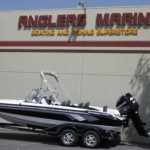
Enter Rick Grover and his staff from Anglers Marine in Anaheim CA. The boat was actually slightly used, it was Ricks Demo boat so it came with a full warranty on everything. Here are the specifics of my new boat.

It’s a 2008 Champion 210 Elite SCX with a Mercury 250 XS with a 10″ Hydraulic Jack Plate and steering. Dual Blinker control on the wheel, one for trim and one for the jack plate. Tilt wheel and the boat sits on a custom tandem axle trailer with disc brakes, spare tire, and swing tongue

For electronics it has a Lowrance LCX-38C HD on the bow and a LCX-28C HD on the console. 36 Volt 109 lb Tour Edition trolling motor w/ Recessed foot pedal. 4 Optima Batteries that sit in 4 Phillips Stainless Steel Battery trays. It also has a 4 Bank on Board Charger.

The rod lockers have custom made rod holders and between the 2 of them they can hold 24 rods and came with a Rod Lock-R-Bar

As you can see, this thing is fully loaded and I love it! I thought the ride in my 201 was smooth but there is no comparison between the 2. This thing is VERY smooth in rough water. The storage space is incredible and there is enough room to plat a football game on. The only down side to all the room is I often find myself packing way too much tackle. I’m a big guy, 6′2, 275 with a 56 inch chest and a 44 inch waist, as you can see by my pictures of me and this boat is more than roomy for me. When I sit behind the wheel I can fully extend my legs without any problems.Fishing out of it is a dream. Its very stable in the water.

Another thing that I love about it is the recessed foot pedal. My old Champion did not have this feature and I didn’t realize just how nice it was until I got this boat. I have bad knees and after a day of fishing my knees would just ache. I used to take a lot of Aleve after a day on the water but not anymore.

Yes I love my boat. The wife calls it my mistress and if I realistically think about it, I guess I cant argue with her, HA!

Thanks for visiting my site. Be sure to tell all of your fishing buddies and come back soon.

Until Next Time, Good Luck and Tight Lines To Ya!

Happy 4th of July!

I recieved this in an email and thought I’d share it with all of you. I dont have any ideal who the author is so I cant give them the credit.

Wishing you all a safe and happy 4th!


Happy 4th of July!
 
I PLEDGE ALLEGIANCE TO THE FLAG, OF THE UNITED STATES OF AMERICA , AND TO THE REPUBLIC, FOR WHICH IT STANDS, ONE NATION UNDER GOD, INDIVISIBLE, WITH LIBERTY AND JUSTICE FOR ALL!

I watched the flag pass by one day.
It fluttered in the breeze.
A young Marine saluted it,
And then he stood at ease.

I looked at him in uniform;
so young, so tall, so proud.
With hair cut square and eyes alert,
he’d stand out in any crowd.

I thought how many men like him
had fallen through the years.
How many died on foreign soil;
how many mothers’ tears?

How many pilots’ planes shot down?
How many died at sea?
How many foxholes were soldiers’ graves?
No, freedom isn’t free.

I heard the sound of Taps one night,
when everything was still.
I listened to the bugler play
And felt a sudden chill.

I wondered just how many times
That Taps had meant ‘Amen.’
When a flag had draped a coffin
of a brother or a friend.

I thought of all the children,
of the mothers and the wives,
of fathers, sons and husbands
With interrupted lives.

I thought about a graveyard
At the bottom of the sea.
Of unmarked graves in Arlington .
No, freedom isn’t free.

Enjoy Your Freedom.

Thanks for visiting my site. Be sure to tell all of your fishing buddies and come back soon

Until Next Time, Good Luck and Tight Lines To Ya!

To borrow a phrase from DW…….

Boogity, Boogity, Boogity, Lets go Fishing Boys!

The days are getting longer and the nights are getting shorter. The daytime temperature is nice and its still a bit nippy at night. The birds have started nesting, Fred and Ethyl are once again nesting on the pillar outside my front door. Yes, spring time has finally arrived! Some people call Christmas the most wonderful time of the year but for me, its spring.

I consider myself lucky to live in a climate where I can go fishing all year round without having to drill a hole in the ice. For those who live in the colder climates there are some things that you need to do to prepare yourself for this time of the year. Servicing your rods and reels and getting the boat ready so you can put it on the water without any worries.

As to serving your rods and reels, if you look back in my archives you will find some helpful tips. Something that I believe I neglected to mention was to check your eye guides on your rods and replace them as needed. One easy way of doing this is to take a Q-tip and run it inside your line guide. If any of the cotton fibers stick to the guide then its time to either replace it yourself or pay someone to do it if you don’t feel comfortable. Some eye guide will pop out easily enough but some will require a re-wrap of the entire guide so it’s up to you if you want to tackle the job yourself or not.

Onto the boat. I’ve got a question for you. Did you remember to drain the gas tank before storing it for the winter or at least put Stay Built or Sea Foam to stabilize the fuel? If not you could be in for a rude awakening if you just attempt to start it up with the old fuel. I suggest draining the fuel and using it in your lawn mower or weed eater or properly disposing of it. Either way I would not suggest running it through your motor as gas breaks down and could cause damage which as anyone who has had to pay for motor damage knows, is very expensive.

Next you want to be sure your impeller is functioning correctly. The impeller is made of hard rubber so over time it will take a “Set” and not flow water as well as it once did. If the water is not flowing the motor will not cool properly and cause it to over heat and blow the power head. Once again, VERY expensive to repair. I personally have my impeller replaced every 2 years as well as the lower end oil. I take mine to a boat shop over at Lake Isabella, my “Home” lake during the winter months because his rates are considerably lower that time of the year.

While there I have the mechanic give my motor a good going over. He checks all of my lines, fuel and oil for leaks or cracks and replaces them as needed. He also removes my prop and cleans out any fishing line that might be in there because if left there could cut into your O-ring and cause water to enter your lower end, which is never good. Yes, it does cost some money but I can promise you that it will cost even more money of you damage the motor. I also like to pull the prop off of my trolling motor and check it for line as well because as mentioned above, it can cut into the O-Ring and allow water into it and cause damage. Be sure your batteries are clean and still work and will hold a charge. If they are dirty clean them up so you will get a good connection.

Some more good practices would be to check your trailers Bearing buddies to be sure they have plenty of grease. I like to press out the old grease by overfilling them until all the old grease comes out and then the new stuff starts to come out. Yes, it is messy but its cheap insurance. Do a visual of your trailer tires. If they appear cracked from sitting, have them replaced. It can be a pain in the back side as well as dangerous to have one of them blow out on you while on the road to the lake, again, cheap insurance. If they are fine then go to the filling station and be sure they are inflated to the proper specifications. If your trailer has brake’s then be sure to check the fluid level, you want to be able to stop when needed.

Yeah, yeah, I know, sound like a lot of work. I’ve heard people call boats” A Hull in the water that you throw money into.” While at time this may be true but think of all the pleasure it has brought you over the years and in my opinion it makes it more than worth it. There are countless other ways to prepare for your initial trip of the year but I believe I have covered some of the basics. Hopefully I was able to give you some pointers of things to look for.

Thanks for visiting my site. Be sure to tell all of your fishing buddies and come back soon

Until Next Time, Good Luck and Tight Lines To Ya!

Fred Halls Fishing Tackle, Boat and Travel Show.


Southern California outdoors people know this is “The Event” to attend because it brings out the child in everyone that attends. I know that I’m like a kid in a candy store, or maybe I should say a huge toy store. The World’s finest fishing tackle manufacturers show up with their latest and greatest products at bargain basement prices. There are Great Deals on fishing tackle, boats, and vacations from Exotic fishing lodges. The show has been billed as California’s Greatest Seminar Line-Up with over 350 Seminars and they also have an insane amount of demonstrations. 

Every year they host 2 shows, one in Long Beach and one in San Diego California.The one in Long Beach will be from March 4th – March 8th 2009 at the Long Beach Convention & Entertainment Center, 300 E. Ocean Boulevard, Long Beach, CA 90802. Admission Price is $15.00 for adults, $14.00 for Military and Seniors and kids under 15 are free with a paid adult.

The San Diego show will be from March 25th – March 29th 2009 at the Del Mar Fairgrounds, 2260 Jimmy Durante Blvd., Del Mar, CA 92014. Admission Price is a little cheaper at this show, $12.00 for adults, $11.00 for Military and Seniors and kids under 15 are free with a paid adult.

I have worked the show several times over the years for some of my sponsors in their booths and always have a great time, I love to talk about fishing and I get my “fix” at the event. I personally feel one of the nicest things, besides all the great things to look at and buy is everyone, and I mean everyone gets along. There is no race issues, no age issues, no discrimination whatsoever. Everyone is outdoors people and we all share a passion for the outdoors like one big happy family.

For the years that I have not had to officially work the show I still like to go down and check it out, dragging Cindy along, HA! Truthfully, Cindy enjoys going, she is just amazed how I turn into a kid when I get into that type of atmosphere because like I stated above, I love to talk about fishing, especially bass fishing. One of my favorite attractions is the Hawg Tank. Its nice to be able to see how bass react to different lures and presentations, even though they are in a controlled enviroment.

Besides all the stuff to buy and look at they always have allot of great things to help keep the kids happy as well as some great food if you get hungry. A couple of things for the youngsters are the casting contest and the Berkley Trout pond that they stock with trout for the kids to catch but beware, kids can be sneaky. Let me explain that statement.

Cindy works with a lady named Sue that went to the show in Long Beach a few years back with her husband and 8 year old son. They had a great time, checking out all the stuff, purchasing a few items, samplings the great food and doing the kid things as well as catching trout from the pond. Now remember, we live up in the high desert so it’s at least a 3 hour drive for us.

 Anyhow, on the way home in the car Sue noticed a strange smell. Joey was sound asleep in the back seat and she asked her husband several times, “What is that smell?” She finally thought that the smell must have been the bait that Joey used while fishing the trout pond and let it go.

They finally arrived home and Joey went off into the bathroom. A few minutes later he called Sue into the bathroom and there in a sink full of water was the trout that he had caught at the show! As it turned out, when they were at the show, the trout that Joey caught had been placed in a plastic bag and he in turn put the bag in with items purchased. He was under the impression that when they arrived home he could place the trout back in water he would once again start to swim.

Go and check it out, make a family fun day of it. In my opinion it’s well worth the time and money spent

Thanks for visiting my site. Be sure to tell all of your fishing buddies and come back soon

Until Next Time, Good Luck and Tight Lines To Ya!

Hooked on Bass, TV Special

I recently received an email from the National Geographic Channel informing me that they were going to air a show that might be of interest to me and it sparked my interest so I did some research on it and it sounds like something that I know I would enjoy so I felt compelled to share the information with you.

The name of the program is Hooked on Bass and it will air on Monday February 2, 2009 at 7:00pm and then again at 10:00pm Pacific Time on The National Geographic Channel. Here in California the National Geographic channel is 186 on The Disk Network so be sure to check your local listings so you dont miss it. I can promise you that I for one will be setting my DVR.

I copied the following information directly from the National Geographic Channel web site that tells about the upcoming broadcast.

“The largemouth bass is more than just Americas most sought after freshwater fish. It fuels an entire culture of followers that pursue the bass at all levels for different reasons: weekend hobbyists, professional tournament anglers, and obsessed record hunters. Some fish to spend time with family and for relaxation, some for the challenge and the connection with nature, and others for the money and obsession. The pursuit of the bass has a $60 billion dollar effect on our economy by the 30 million bass anglers, a sport which has become the most popular outdoor activity in America. Three stories typify the culture of bass fishing, and happen on three different lakes across the country. In Texas, on Lake Sam Rayburn, weekend angler Rusty Clark fishes in one of the worlds largest amateur bassfishing tournaments. In New York, on Lake Oneida, Kevin Van Dam tries to secure his year-long quest to be the top professional in the sport. And in California, on Dixon Lake, three world record hunters obsessively hunt one fish that they believe to be the biggest bass of all time.”

As you can see, it sounds like its going to be a great program. They also have a short video clip showing actual footage of Dottie, the 25.1 pound largemouth bass that was caught by Mac Weakley at Lake Dixon in California on March 21, 2006 but was released because it was accidentally foul hooked and Mac is a true sportsmen. Dottie was the same bass thar Mac’s friend Jed Dickerson had caught in May 2003 when she weighed 21.7 and Mike Long had caught her back in April 2001. For the next 2 years Dottie was able to avoid being caught so the hope of catching the new world record bass still gleamed at Lake Dixon until May 9, 2008 when she was found dead floating on the surface. She died of natural causes and had apparently spawned out and weighed only 19 pounds, still a monster bass by any ones standards.

I for truly still believe that the next world record bass will come from the fertile waters of a California lake.

Be sure to either watch this program live or set your TIVO so you wont miss it. Check back here after the airing as I will be discussing the program and my views on it.

Thanks for visiting my site. Be sure to tell all of your fishing buddies and come back soon

Until Next Time, Good Luck and Tight Lines To Ya!

Next Page »

Wounded Warrior Project


eMail your comments to Mike (at) bassnman.com
Who Is BassnMan?   |    Privacy Policy   |    Terms of Use
Easy AdSense by Unreal